Area guide · Northern lights
Guide to viewing aurora in Tobermory
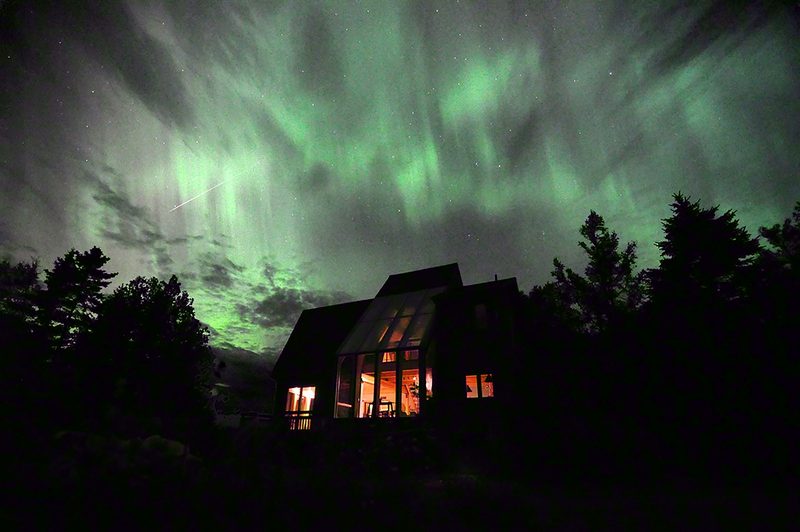
Northern lights are rare, but not as rare as you may think. Here at our cottage in Tobermory ON, they come a few times a year. What makes them feel like a once in a lifetime thing is that everything has to be right on the same night: a clear sky, a dark northern horizon, a moon that is not too bright and a solar storm that happens to arrive while you are awake. Catching one takes luck, plus a bit of knowledge and planning. The luck is out of your hands, this guide covers the rest.
In short: Kp 5 means some chance of seeing aurora above the horizon, Kp 7+ means great chance of overhead aurora. Check the forecast for tonight and tomorrow, then live conditions for the next hour.

If you are our guests staying at the cottage, you were probably referred to this page by me because the conditions tonight look promising. If you found this some other way, feel free to read on too, we are happy to share a little knowledge. Almost all of it applies anywhere in southern Ontario.
As an ex-physicist, I find the northern lights fascinating. If we were sitting over coffee, I'd happily explain how they work as a beautiful mix of classical electromagnetism and modern quantum physics. Here I'll keep it simple and stick to what you actually need in order to see them.
What the Kp number means
Every aurora forecast is built around one number called Kp. It runs from 0 to 9 and it measures how much the solar wind is shaking the Earth's magnetic field. The northern lights sit in a ring around the magnetic pole. When a solar storm arrives and Kp goes up, that ring grows and pushes south. The one main question: does it come far enough south to reach us?
Here on the Bruce Peninsula, and across most of Southern Ontario, this is what the Kp number really means.
- Kp 4 or lower Nothing your eyes will catch. Go to sleep.
- Kp 5 Worth checking outside. A pale arch low in the north, usually grey or white to the eye, clearly green in a photo.
- Kp 6-7 Worth waking people up for. Color you can see without a camera, and shapes that move while you watch.
- Kp 8-9 Red and pink dancing over your head, the nights that end up on the news.
Two notes: NOAA also labels storms G1 through G5, where G1 is about Kp 5, so both scales turn up on the same page. And because Kp averages 3 hours across the whole planet, a good 20-minute show can hide inside a quiet number.
The 2 resources
These are the 2 websites I monitor regularly. The first is a forecast, for deciding whether tonight is worth staying up for. The second is live, for deciding whether to put your shoes on right now. Both pages are free, no account needed.
The forecast: the NOAA aurora dashboard
The NOAA aurora dashboard is where I start. The top of the page answers the first question: will I see the aurora tonight or tomorrow night. You get a globe with the forecast painted on it, green where the chance is low and red where it is high. The forecast Kp is printed at the top.
For timing, scroll to the 3-Day Forecast table further down the same page. It gives you a plain table called the NOAA Kp index breakdown: 3 days across the top, 8 rows of 3 hours each down the side.
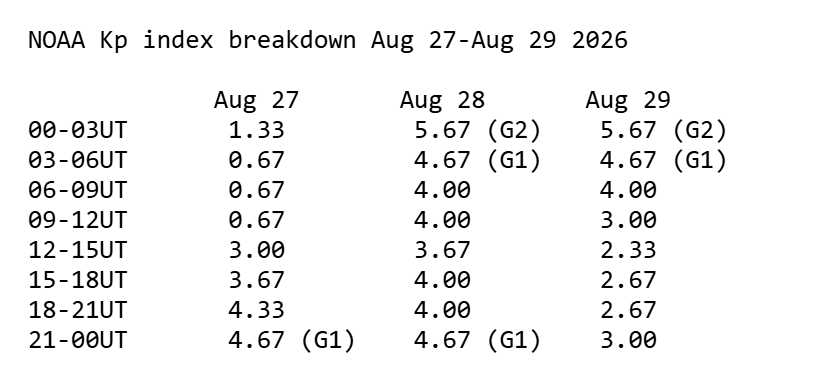
Note that the time in that table is UT, 4 hours ahead of us in summer and 5 in winter. In summer the rows that cover a night here are these.
- 00-03UT is 8 to 11 in the evening
- 03-06UT is 11 at night to 2 in the morning
- 06-09UT is 2 to 5 in the morning
The part that catches everybody is the date. Those rows sit under tomorrow's column. On a Thursday evening, the number for 11 o'clock tonight is under Friday in the table.
Live conditions: SpaceWeatherLive
A forecast written 12 hours ago can be wrong by the time it gets dark. SpaceWeatherLive shows what the solar wind is doing right now, measured by a spacecraft parked about 1.5 million km out toward the sun. Whatever it reads reaches us 30 to 60 minutes later, and that gap is your warning.
I look at 2 things on it.
How long until it gets here. The page says it in a sentence near the top: with the current speed, the solar wind will take so many minutes to reach Earth. Every chart below has a vertical line marked Earth. Everything left of it has already passed us, everything right of it is still on the way. So when the numbers turn good to the right of that line, that is your countdown.
Bz. This is the number that decides the night. It is the direction the sun's magnetic field is pointing when it arrives. A negative Bz points south, opposite to ours, and the 2 fields can then link up and let energy in. With a positive Bz very little happens, however good everything else looks. Below -10 nT is a good night. Below -20 nT, put your shoes on.
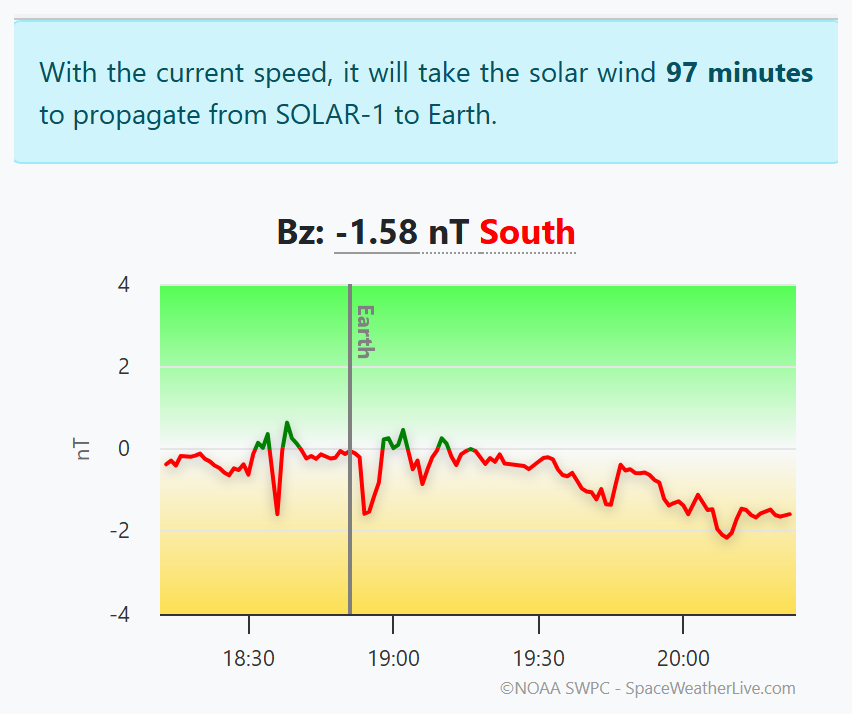
Speed and density are worth a glance. Above 500 km/sec helps and a density above 20 makes it brighter. Neither one rescues a night with the wrong Bz.
Viewing tips
- Face north, over open ground. From our shore facing the lake it means looking to the right. Anywhere else, look for water or a field with a low northern horizon and no yard lights.
- Use your phone to check Night mode on any recent phone sees the aurora well before your eyes do. Point it low at the north and let take a night mode photo. Green in the photo means you've caught it. Yellow glow most likely just means light pollution from a nearby town/city.
- Give your eyes 15 minutes. Dark adaptation is chemical and it takes that long. Turn all the lights off. Try not to use your phone, it undoes the process.
- Wait longer than feels sensible. It arrives in waves. An empty sky at midnight can be a full display at 1:15 and finished by 2. Most people who miss the northern lights were standing outside during the wrong 20 minutes.
- Dress appropriately Clear nights are the cold ones, and doing nothing by the water in August is colder than it sounds.
If you are staying with us and the conditions look promising, I will usually send you a message. We are watching the same 2 pages above. And if you go out and see nothing, that is the normal outcome. Try checking the live conditions again in an hour. That second check might be the difference between people who have seen the northern lights and people who have not. Some of it is still luck, so I'll keep my fingers crossed for you.
Keep planning
Where to go next
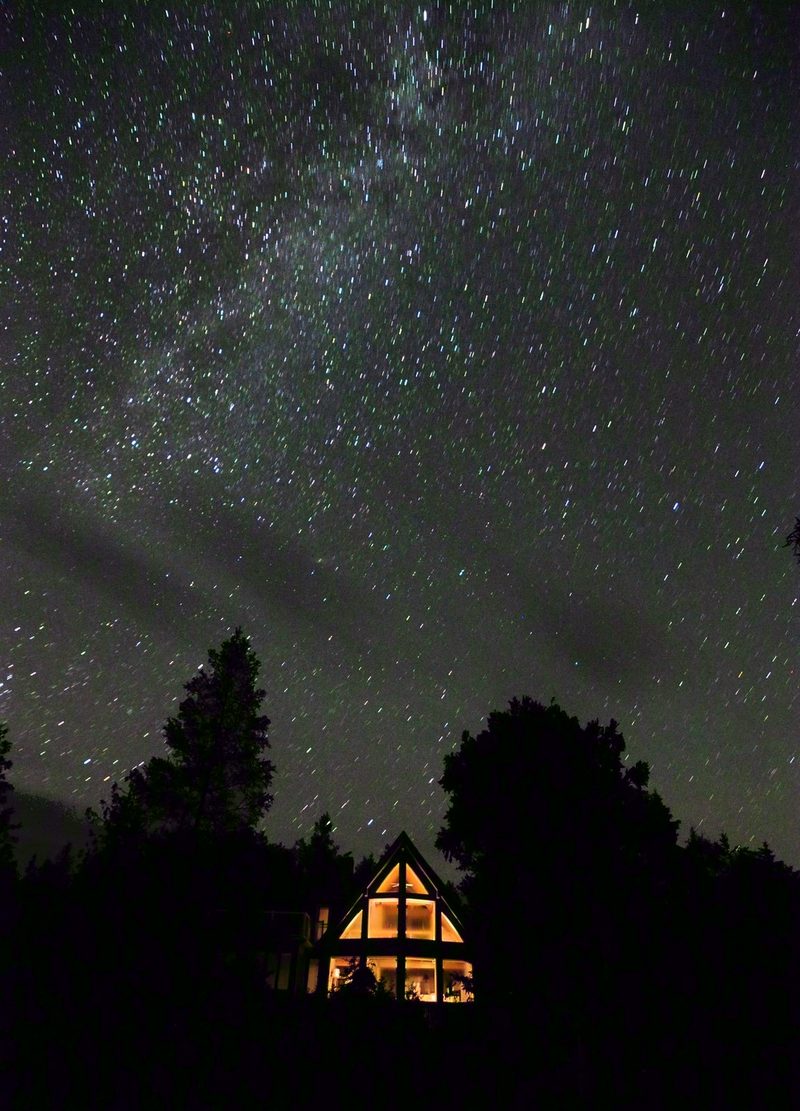
Watching the dark sky
The moon, your eyes and the 20 minutes that decide what you see on any dark night.
Read the guide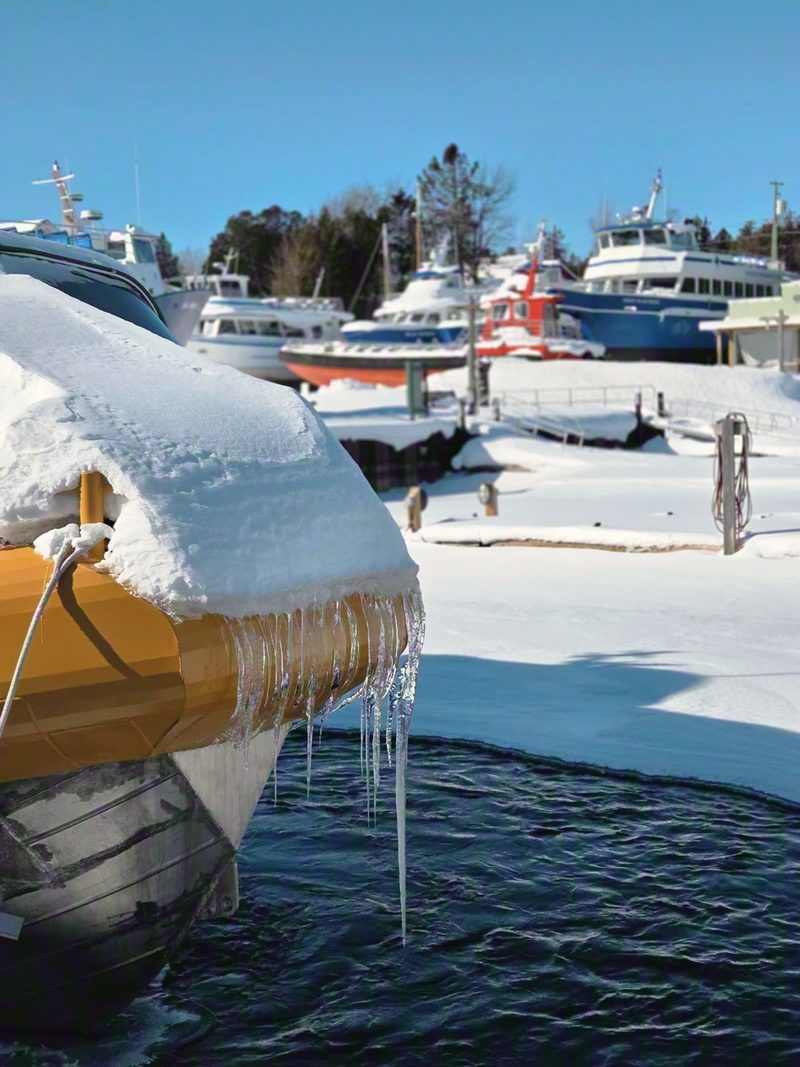
Tobermory in winter
Dark by 6 and clear for weeks. The long nights are the best aurora season we get.
Read the guide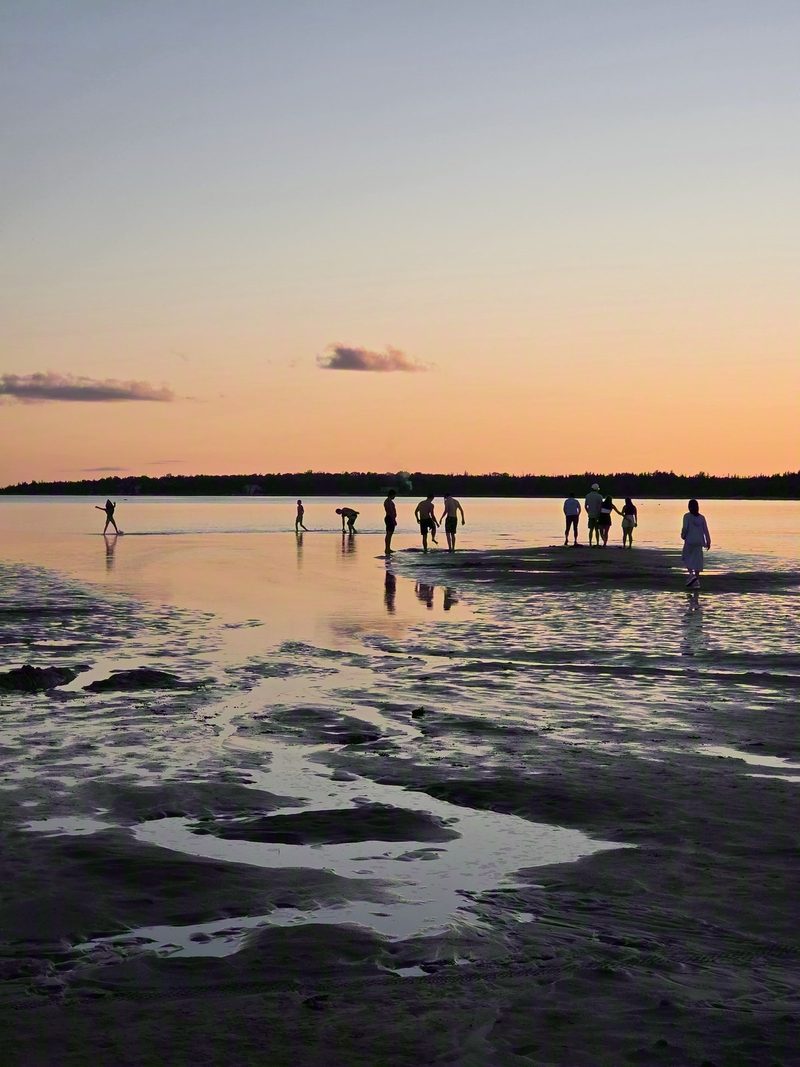
Singing Sands
The low horizon that makes a night sky work here, and what the same beach does by day.
Read the guide